Patient Caregiver Matching - caregence

Patient Caregiver Matching

Patient-Caregiver Matching Agent

Smarter scheduling. Happier caregivers. Consistent care for every patient.

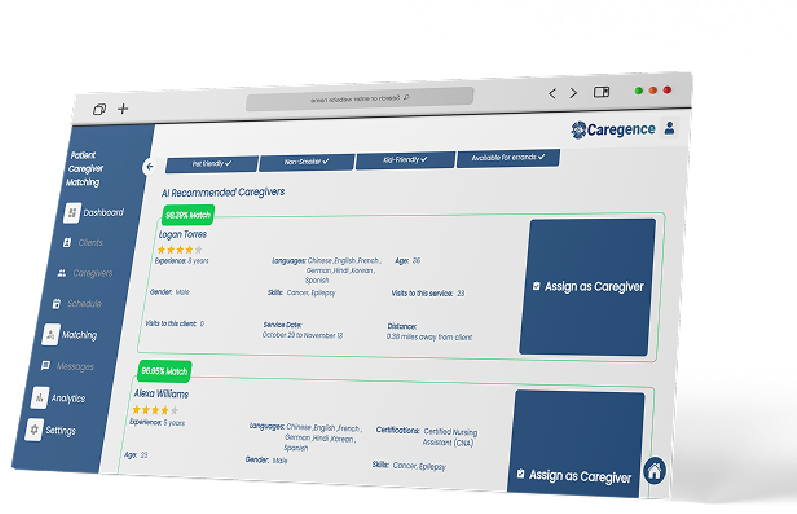
Built on the Caregence platform, the Patient-Caregiver Matching Agent connects human insight with AI precision. It helps home healthcare agencies align caregiver skills, geography, and patient needs; creating a system where both patients and caregivers thrive. The agent learns from every visit, predicts burnout risks, and improves scheduling efficiency with each cycle.

The problem it fixes

Caregiver Retention

High turnover remains one of the biggest issues in home care. When schedules don’t align or workloads grow unbalanced, caregivers burn out and leave, disrupting patient relationships, driving up costs, and reducing quality of care.

Underutilized Workforce

Without intelligent scheduling, capacity is lost in transit time, uneven assignments, and missed visits. Some caregivers are stretched thin while others have idle hours,all while patient demand keeps growing.

Burnout and Fatigue

Caregivers face long commutes, heavy caseloads, and unpredictable shifts. Without a view into fatigue trends, managers struggle to act before burnout hits.

Patient Satisfaction and Trust

Patients notice when caregivers change too often or arrive underprepared. Consistency builds confidenceand drives higher satisfaction and retention.

What the patient caregiver matching agent does

Caregiver recruitment optimization

Spot staffing gaps early, track applicants in one place, and move candidates to onboarding faster.

Scheduling, routing, and matching

Align visits with caregiver skills, geography, travel time, risk level, and patient preferences for a better daily plan.

Burnout prediction and prevention

Watch hours, travel load, schedule volatility, and time-off signals. Recommend fair workload shifts before fatigue shows up.

Caregiver
enablement

Share real-time patient profiles, visit prep, safety notes, and quick checklists so field staff arrive ready.

Predictive analytics for patient risk

Flag high-risk patients using history and context so teams can act before readmissions or escalations.

How it works on the Caregence Platform

Location scoring for route efficiency

Reduce travel distance and time to lower costs and improve punctuality.

Hybrid recommendation engine

Rank matches using availability, proximity, compatibility, and performance to produce a best-fit list for each visit.

Workload scoring for balance

Distribute visits evenly to avoid fatigue and last-minute call-offs.

Pattern matching for fit

Map caregiver skills, language, preferences, and past outcomes to patient needs.

Outcomes that
Matter

Salient features

Model-agnostic on the Caregence platform

Works with your preferred AI models while keeping HIPAA controls intact.

Plug-and-play integrations

Connects to EHR, HRIS, scheduling, payroll, EVV, and maps your existing codes and skills.

Hybrid matching engine

Weighs skills, proximity, availability, language, preferences, and past outcomes for each visit.

Burnout early-warning

Uses signals like hours, travel load, cancellations, and schedule volatility to flag fatigue risks.

Route and shift optimization

Cuts commute time and balances shift distribution to reduce idle hours and overtime.

Real-time availability sync

Reads time-off, PTO, and open windows to avoid dead-end matches and no-shows.

Caregiver enablement

Visit prep, patient context, safety notes, and quick checklists on mobile.

Explore our other AI-powered agents

FAQs

How customizable is the matching logic?

Weights and rules are configurable by region, program, payer, and skill group. You can pin required skills, set distance limits, and define preference tiers.

How does it prevent burnout or unfair assignments?

It tracks load, travel, shift patterns, and last-minute changes, then recommends balancing moves. You can enforce fairness rules and cap weekly hours per role.

What data sources does it use?

EHR for patient context, HRIS and credentialing for skills, scheduling and EVV for availability and travel, payroll for overtime signals, and optional survey inputs for preferences.

Will caregivers see why they were assigned?

Optionally, yes. You can show a short rationale like skill match, language fit, and proximity to build trust and transparency.

What about language and cultural fit?

You can tag caregiver capabilities such as languages, cultural familiarity, and home preferences. The agent includes them in the fit score.

Is it HIPAA compliant?

Yes. Data is encrypted in transit and at rest, PHI is masked by role, and every change is recorded with a full audit trail, adhering to HIPAA regulations.

Transform caregiver scheduling in real time

Experience how Caregence’s Patient-Caregiver Matching Agent transforms scheduling and retention through AI-powered intelligence.